

Get 10% off at Keratin.pro! Enter the promo code NANOCOLOR2 at checkout! P.S. The promo code is valid for all products except those already discounted.
Contents
What nanoplasty is and how it works on colored hair
Can nanoplasty be done after coloring
How nanoplasty affects hair color
Features of working with blonde and lightened hair
Nanoplasty for blonde and damaged hair: a solution for a challenging base
Mistakes masters make during nanoplasty on colored hair
Care after nanoplasty on colored hair
Colored hair requires a particularly delicate approach during any deep restoration and smoothing procedures. That is why nanoplasty on colored hair raises many questions among both clients and masters. Can the procedure be performed after coloring? How does the pigment react to thermal exposure? Does the shade change after straightening? And most importantly — how to achieve smooth, shiny hair without losing color and hair quality.
Nanoplasty is considered one of the most popular procedures for disciplining frizzy, wavy, and porous hair. Unlike classic keratin procedures, modern formulas mainly work not on formaldehyde and its derivatives, but on amino acids, organic acids, proteins, and conditioning components. That is why the procedure is often positioned as a possible alternative for clients with damaged or lightened hair. However, in reality, nanoplasty is a more powerful hair smoothing method than keratin — it chemically changes the hair structure. Therefore, this procedure should be approached with caution when performed on colored curls.
Colored hair has its own specifics. It has already undergone chemical intervention, which means the cuticle is partially open, the lipid layer is disrupted, and the structure is more sensitive to temperature and acidic environments. A master working with such clients must consider not only the application technique, but also the hair history, type of dye, and degree of damage.
What nanoplasty is and how it works on colored hair
Nanoplasty is a hair reconstruction and smoothing procedure during which active components penetrate the structure, densify the hair fiber, reduce frizz, and help create a smoother strand. The main effect is achieved through the action of acids and amino acids combined with high flat iron temperature. You can learn a little more about it in our article Nanoplasty for hair. Who this procedure is suitable for.
On colored hair, the procedure works differently than on natural hair. The reason lies in the altered structure of the cuticle layer. Hair after coloring has already lost part of its natural protection, so the formula may penetrate faster and more actively.
Before starting work, the master should assess the hair condition according to several criteria:
- level of porosity;
- hair elasticity;
- degree of end damage;
- presence of lightened or bleached zones;
- history of previous procedures.
Such analysis allows predicting the result and reducing risks. It is not advisable to work with colored hair without prior diagnostics.
Can nanoplasty be done after coloring
One of the most common questions among clients is when it is better to perform the procedure: before coloring or after. There is no single answer, since everything depends on the desired result, type of dye, and hair condition.
In most cases, masters recommend performing coloring first and only after a certain period carrying out nanoplasty. This is explained by the fact that the procedure may affect cosmetic pigment due to the acidity of the formula and high-temperature sealing.
The optimal intervals between procedures are as follows:
- after toning — 7–10 days;
- after permanent coloring — 10–14 days;
- after lightening or bleaching — 14–21 days;
- after transitioning from black or complex lightening techniques — individually after a strand test.
Following these recommendations helps stabilize the pigment inside the hair. It also reduces the risk of uneven color after the procedure.
How nanoplasty affects hair color
It is important for the master to warn the client that nanoplasty may affect the shade. This especially applies to cool blondes, bright fashion colors, red and copper pigments. Under the influence of temperature and acidic components, the following changes are possible:
- washing out of toning pigments;
- warmer shade tone;
- appearance of yellowness on lightened hair;
- slight lightening of the length by 0.5–1 tone;
- uneven color on porous sections.
Such reactions are predictable, not accidental. That is why a proper consultation before the procedure is a mandatory part of a master's work.
To minimize the risks of color changes, it is recommended to use a lower temperature setting where the hair condition allows it. Particular care should be taken when working with blonde hair and hair after powder lightening.
Features of working with blonde and lightened hair
Lightened hair is considered the most challenging base for nanoplasty. Due to the destruction of natural pigment and the aggressive effect of oxidizing agents, such hair often has high porosity, brittleness, and unstable structure. Before the procedure, the master must ensure that the hair can withstand thermal load. For this, it is important to evaluate the following indicators:
- hair does not stretch like rubber when wet;
- ends do not break under tension;
- the hair canvas retains minimum density;
- there is no massive splitting along the length;
- hair does not crumble during drying.
If at least several points raise doubts, it is better to postpone the procedure. In such cases, the priority should be reconstruction and restoration, not straightening.
Nanoplasty for blonde and damaged hair: a solution for a challenging base
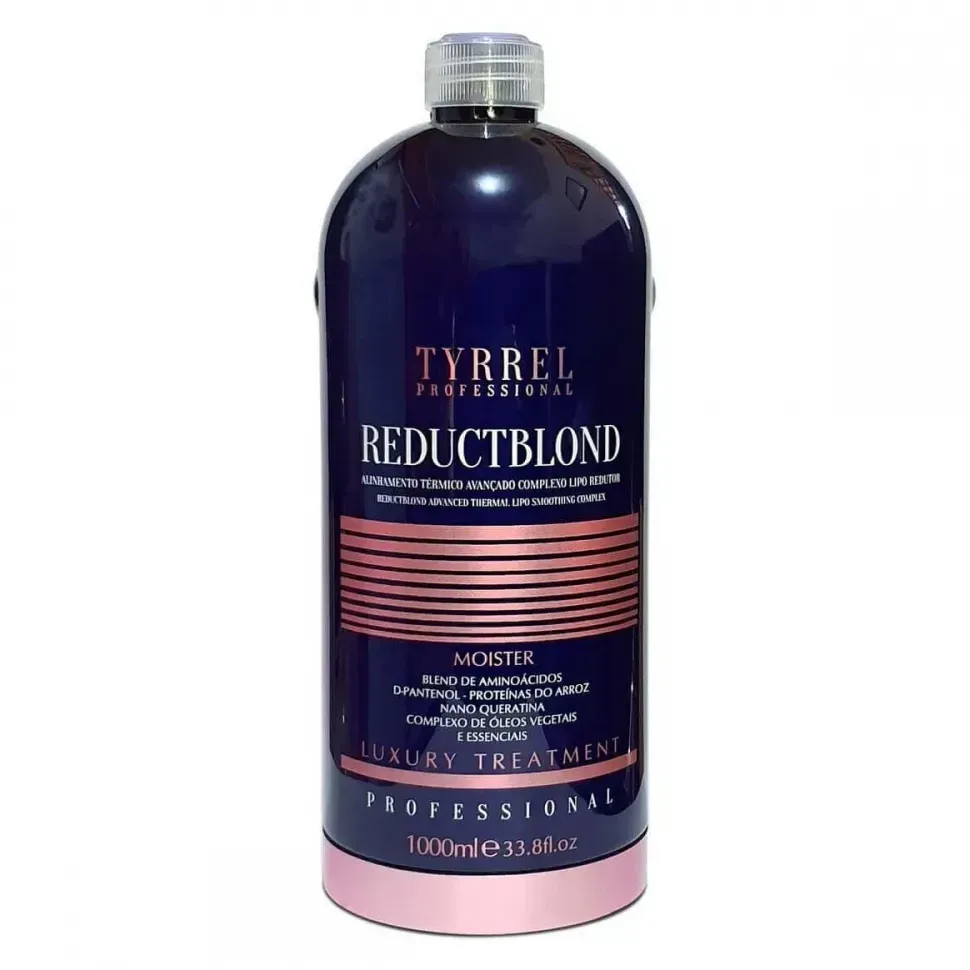
When working with lightened and colored hair, it is especially important for the master to select formulas adapted to porous and sensitive structures. In such cases, attention should be paid to products specifically designed for blonde hair and hair with damaged areas.
Tyrrel Reductblond is a professional nanoplasty formula focused on smoothing, reconstruction, and disciplining light hair. A complex of amino acids, plant and essential oils helps reduce frizz, make the hair smoother, more elastic, and visually denser. The product also has a light toning effect that helps neutralize unwanted warm and yellow tones, which is especially relevant for blonde hair after lightening. During the procedure, the formula supports restoration of the hair lipid layer, improving hydration level and softness of the hair canvas. With properly selected technique and home care, the smoothing effect can last up to 7 months.
These types of products allow the master to work with a more complex base without compromising between smoothing and hair quality. This is especially relevant for clients who want to maintain a well-groomed blonde appearance and achieve a more disciplined hair structure after the procedure.
Mistakes masters make during nanoplasty on colored hair
Even a good formula does not guarantee a perfect result if the technology is violated. Most often, problems arise precisely because of incorrect base assessment or ignoring the specifics of colored hair.
The most common mistakes in work:
- performing the procedure immediately after coloring;
- using excessively high temperature;
- too many passes with the flat iron;
- absence of a strand test;
- applying the formula to critically damaged hair;
- incorrect processing time.
Each of these mistakes can lead to dryness, color loss, or even breakage. A professional approach always begins not with applying the formula, but with proper diagnostics.
Care after nanoplasty on colored hair
After the procedure, it is important for the client to maintain the result with proper home care. Not only the duration of smoothness but also color stability depends on it.
After the procedure, recommend the following rules to the client:
- use gentle sulfate-free cleansing products;
- avoid deep cleansing shampoos unless necessary;
- regularly use moisturizing masks;
- use heat protection before styling;
- maintain color with toning products when needed;
- protect hair from ultraviolet exposure and chlorinated water.
Comprehensive home care prolongs the effect of the procedure. In addition, it helps preserve shine, density, and shade richness.
Who nanoplasty on colored hair is not suitable for
Despite the popularity of the procedure, there are cases when it is better to refuse nanoplasty. This is not a limitation, but a matter of professional ethics and the safety of the client's hair.
It is not recommended to perform the procedure in the following cases:
- hair after unsuccessful lightening in critical condition;
- severe breakage along the entire length;
- hair does not pass the elasticity test;
- presence of active hair loss due to scalp damage;
- recent aggressive bleaching.
Refusing the procedure is sometimes the best decision. This helps preserve the client's hair and the master's reputation.
Nanoplasty on colored hair is a procedure that requires high competence from the master, understanding of chemical processes, and the ability to work with different hair types. Colored hair can produce excellent results after the procedure: smoothness, shine, discipline, and reduced frizz. But only with proper diagnostics, correctly selected temperature, and adherence to technology. Before choosing which procedure to perform on colored curls, it is also useful to read our article Keratin, botox, or nanoplasty — what to choose in 2026?.
The main rule for a master is not to work with a standard template approach. Every colored hair has its own history, level of damage, and reaction to active components. It is exactly the individual approach that distinguishes a professional from a performer.
If all nuances are taken into account, nanoplasty on colored hair can become a safe and highly effective procedure that gives the client a predictable and beautiful result.
Where to choose professional products for nanoplasty
The quality of the result after the procedure directly depends not only on the master's technique but also on the correctly selected formula for working with a specific hair type. That is why it is important for professionals to use trusted products designed for various client needs — from working with natural hair to complex cases with blonde, colored, and damaged bases.
In the online store KeratinPro, there is a wide selection of professional hair straightening products, as well as hair care products. In particular, you can order nanoplasty, keratin straightening, botox, and hair reconstruction products from us. Here, masters can choose products for different techniques and levels of hair damage, as well as find supporting care products to maintain results after procedures. The product range is regularly updated according to current market trends and the needs of the professional industry. By choosing high-quality formulas and care products, the master gets a more predictable result, and the client gets healthy, smooth, and well-groomed hair.
You can also read other interesting articles from us, including: